“That’s how life goes”

I remember that quote from a little while ago. It was said by GM Hikaru Nakamura after his defeat against GM Fabiano Caruana in the FIDE Candidates 2026. At the time, Hikaru was the World No. 2 in the FIDE rankings, and that defeat temporarily threw him into the “loser / no longer a challenger” basket. But don't worry, I’m not here to talk about chess.
Let me get straight to the point.
What does this "life" that Hikaru talked about actually mean?
Life is a chaotic collection of wins, losses, backlashes… everything. Its success is mainly about how we respond to our environment and our inner self. We need to talk about how we handle all of these things.
First, let me bring you some recent news.
GM Javokhir Sindarov won the 2026 Candidates tournament to challenge the current world champion, GM Dommaraju Gukesh, amazing the entire world. He even defeated the tournament favorite, GM Fabiano Caruana. To make things even more incredible, his girlfriend, WGM Bibisara Assaubayeva, took second place in the 2026 Women's Candidates tournament.
Wow!
Everybody is cheering for them. It reminds me of those social media reels playing the song that goes, “The winner takes it all…”
That positive response from people is okay. But the flip side of public reaction is absolutely not okay.
In another part of the world, a man in India tragically committed suicide. This was the result of a viral video shared by a social media influencer who falsely claimed he touched her inappropriately on a train ride. In reality, he hadn't. But the internet mob subjected him to brutal harassment and public shaming, all because an influencer wanted to gain social media reach.
So, what’s the lesson here?
People can say literally anything they think of, whether it’s a truth, a lie, or absolute nonsense. And letting that public nonsense consume you can drive a person to the deepest depths of despair, even to suicide.
I’ve seen a lot of Western psychological frameworks offering solutions like “Take a break” or “Talk to a friend.” I guarantee you, these are temporary band-aids. They do not provide an ultimate, bulletproof solution.
When we look into Theravada Buddhism, however, there is a perfect solution for understanding life and responding to this exact type of nonsense.

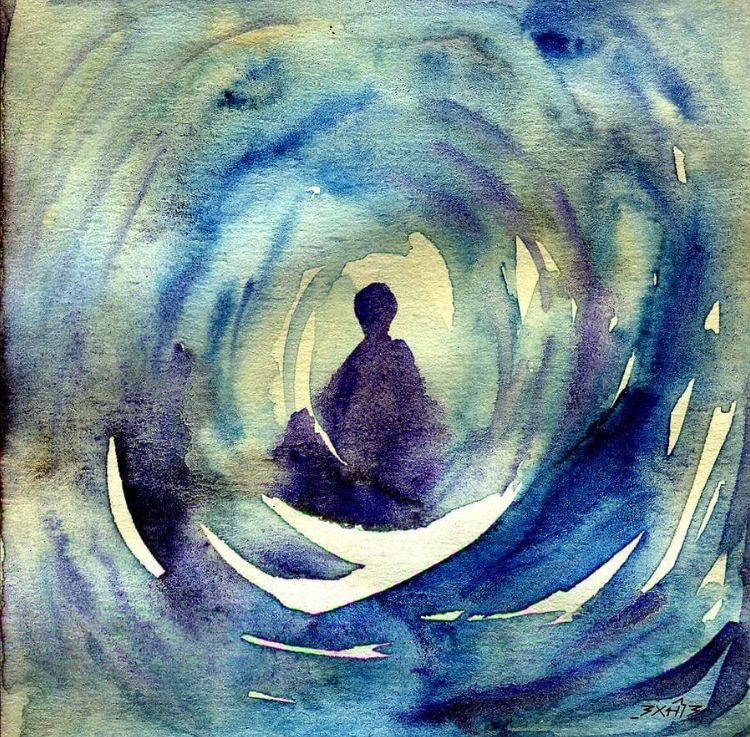
Conventionally speaking, a person is defined by two parts: the Mind and the Body. According to social sciences and conventional truth (Sammuti Sacca), this definition works. But people get into deep trouble because they mistake this convention for the absolute reality.
Let’s dig into the ultimate truth (Paramattha Sacca) of the mind and the body.
In Theravada Abhidhamma, the body is called Rūpa (matter). It is primarily made of the Avinibhoga Rūpa, the eight inseparable material qualities found in all matter:
- Pathavī (solidity; hardness/softness)
- Āpo (cohesion; the ability to bind or stick together)
- Vāyo (motion, vibration, or pressure)
- Tejo (heat/temperature)
- Vanṇa (color/visibility)
- Gandha (odor/smell)
- Rasa (taste/flavor)
- Ojā (nutritive essence)
Depending on where it is located in the body, other material qualities are added, such as Cakkhu Prasāda (eye-sensitivity) or Jīvitindriya (physical life-faculty).
Everything we see in the external environment is also made of Rūpa, containing these exact same eight inseparable elements. Buddhism explains that Rūpa is generated by four causes: Karma (Kammaja), Mind (Cittaja), Temperature/Seasonality (Utuja), and Food (Āhāraja).
The lifespan of a single Rūpa unit is incredibly brief—lasting only 17 mind-moments (Citta-vīthi). After those 17 moments, that Rūpa perishes, and a new one arises. Think about the soil under your feet; it is also made of Rūpa that arises and passes away every 17 mind-moments. Ultimately, there is no structural difference between the Rūpa making up your body and the Rūpa in the dirt. The physical body just acts as a temporary, supportive biological infrastructure to continue life until death.
When considering the Mind, it is not a solid "soul," but an unbroken, rapid succession of individual mind-moments (Citta). This stream only stops when a person achieves final liberation (Nirvana). Within this stream, these consciousness-units are causally related, but they are completely distinct. One Citta arises only after the total disappearance of the previous one. Nothing of the old mind-moment remains in the new one.
How does the mind-body interaction happen?
Think of a person speaking to you. First, a series of mind-moments arises in them to formulate a thought. Then, another set of mind-moments triggers the mind-produced matter (Cittaja Rūpa) in their body to physically speak, creating sound waves (Sadda Rūpa).
So, if a person shouts insults at you, understand what is actually happening in ultimate reality: it is just a mechanical collision of Rūpa (sound waves) hitting your Rūpa (ear-sensitivity). Nothing more. Based on their own unwholesome intentions (Kamma), they will inevitably suffer the results of their actions later. But right now, it is just sound vibrations in the air.
The Ultimate Release: It’s Just Paṭiccasamuppāda
When you truly realize this, the entire weight of social anxiety, blame, and public judgment evaporates.
When someone attacks you online or offline, your ego immediately jumps in to say, "He blamed me," or "The public hates me." This "me" and "I" are the illusions that cause your suffering.
Look closer through the lens of the Dhamma. Who is the one blaming? It is just a collection of five aggregates, rapidly changing Citta and Rūpa, acting out of ignorance. And who is the "me" being blamed? Just another passing stream of material elements and mental moments.
There is no permanent "person" inside that train, inside that computer screen, or inside your own head. There is no independent "abuser," and there is no permanent "victim."
It is nothing more than Paṭiccasamuppāda, the Law of Dependent Origination.
When this exists, that comes to be; with the arising of this, that arises. When this does not exist, that does not come to be; with the cessation of this, that ceases.
An ignorant thought arises in someone's mind → sound waves are produced → sound waves hit an ear-drum → auditory consciousness arises → the mind falsely interprets it as "insult" → suffering arises.
It is just a chain reaction of natural causes and conditions. It is a completely impersonal, natural process.
When you fully digest this truth, you realize there is absolutely nothing to worry about. The words "He blamed me" or "The people blame me" lose their power entirely, because you realize there is no "He," there is no "People," and there is no "Me."
It’s just Paṭiccasamuppāda playing itself out. Understand the process, detach from the illusion, and find your peace.